Most “digital marketing” advice fails in one of two ways: it’s either a list of tactics with no strategy, or it’s strategy with no measurement. In reality, digital marketing is a system channels, data, creative, and governance working together to reach an audience, shape decisions, and produce measurable business outcomes.
This article is written to match common user intent (learn, compare, plan, measure, and stay compliant) while staying neutral and reference-friendly. It explains what digital marketing includes, how it evolved, how each major channel works, how to plan and measure, and why privacy/regulation now changes execution.
What Is Digital Marketing? (Definition and Scope)
Digital marketing is the use of digital technologies and digital media to communicate marketing messages, create demand, and influence purchasing decisions. It includes activities conducted on the web (search, social, email, websites) and also marketing delivered through other digital systems (e.g., SMS, in-app messaging, connected TV).
A practical way to understand scope is by the media model:
- Owned media: website, blog, email list, mobile app, customer community
- Paid media: search ads (PPC), paid social, display/programmatic, sponsorships
- Earned media: PR mentions, backlinks, reviews, influencer mentions, shares
Digital marketing also overlaps with supporting capabilities such as marketing automation, analytics, conversion rate optimization, and customer relationship management (CRM) because the ability to measure and improve is a defining feature of the digital environment.
Digital marketing vs. online marketing (what’s the difference?)
Online marketing usually refers to marketing that happens on the internet (websites, email, social platforms, search engines). Digital marketing is broader: it includes online marketing and non-web digital channels that still deliver marketing through digital infrastructure.
This distinction matters operationally. If you only plan “online,” you may miss important parts of modern customer communication such as push notifications, SMS, app-based offers, or connected TV placements that influence search and conversions.
Internet and non-internet digital channels (TV, SMS/MMS, in-app, etc.)
A complete digital mix can include:
- Search engines (organic + paid)
- Social media platforms (organic community + paid distribution)
- Email (newsletters, lifecycle automation)
- Apps (push notifications, in-app messages)
- SMS/MMS (time-sensitive and transactional communication)
- Connected TV / streaming (brand reach with digital targeting features)
- Digital out-of-home (location-based digital placements in physical environments)
Even when channels look different, they share a core advantage: digital marketing is typically more measurable and iterative than many traditional media forms.
A Brief History of Digital Marketing (1990s to Today)
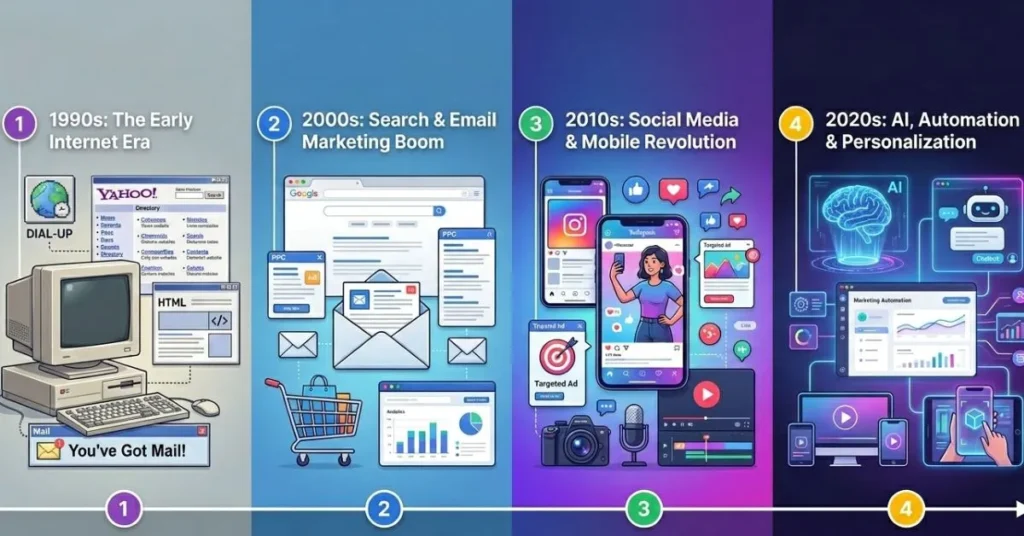
Digital marketing didn’t appear fully formed; it evolved as the web, mobile devices, and ad platforms matured.
1990-1999: early search, websites, and email
As the web became accessible, businesses began publishing information and using email for direct communication. The core dynamics started here:
- being discoverable through early search and directories
- using websites as always-available brochures and lead capture tools
- using email as a direct channel to existing contacts
2000-2009: PPC, smartphones, and early social platforms
The early 2000s introduced paid search at scale and made marketing more “engineered”: keywords, bidding, and conversion tracking became standard. As smartphones entered the mainstream, customer behavior shifted toward researching products anytime and anywhere, shrinking the distance between discovery and action.
A reliable reference for paid search mechanics is Google’s documentation of the ad auction (how bids and relevance shape ad placement):
Source link: https://support.google.com/google-ads/answer/1722122
Social platforms also changed distribution: brands could publish content directly into feeds and interact publicly with customers creating both opportunity (reach, engagement) and risk (reputation management in real time).
2010-present: programmatic ads, automation, and omnichannel
In the 2010s and beyond, digital marketing became less about individual tactics and more about systems
programmatic advertising (automated buying and targeting of display inventory)
marketing automation (behavior-triggered messaging across channels)
omnichannel expectations (consistent experience across devices and platforms)
deeper focus on attribution, incrementality, and privacy compliance
Core Digital Marketing Channels
This section explains the major channels and where they typically fit in the funnel (awareness → consideration → conversion → retention).
Search engine optimization (SEO)
SEO improves a site’s ability to appear in organic search results for relevant queries. Modern SEO is less about repeating keywords and more about:
- covering topics comprehensively (topical authority)
- aligning content to search intent (informational, commercial, transactional)
- building a crawlable, fast, well-structured site
- earning trust signals (citations, references, reputation, links)
Google’s SEO Starter Guide is a stable baseline reference:
https://developers.google.com/search/docs/fundamentals/seo-starter-guide
Search engine marketing (SEM/PPC)
SEM typically refers to paid search (often PPC). It’s effective for capturing high-intent demand quickly especially for queries that show clear purchasing intent (“buy,” “pricing,” “near me,” “best,” “software”).
For attribution models in Google Ads (including data-driven attribution where available):
https://support.google.com/google-ads/answer/6259715
Content marketing
Content marketing creates value by explaining, comparing, educating, and helping users make decisions. Good content marketing is not “posting a lot.” It’s building an information system:
- guides
- explainers
- case studies
- tools/templates
- research summaries with citations
Social media marketing
Social media marketing uses social platforms for distribution, community, customer support, and paid targeting. It works best when you separate:
organic (community, brand voice, social proof)
paid social (targeted distribution, testing creative and offers)
Email marketing
Email is “owned attention” (you’re not renting reach from an algorithm). It’s effective for:
- onboarding sequences
- product education
- newsletters that build habit
- lifecycle messaging (renewals, churn prevention)
Display & programmatic advertising
Display advertising places visual ads across websites and apps. Programmatic systems automate buying and targeting, often using audience signals. Display is usually strongest for:
- building awareness
- supporting search demand (people later search for the brand)
- Retargeting
Influencer marketing
Influencer marketing leverages creators who already have audience trust. It performs when:
- the influencer’s audience matches the brand’s segment
- the content fits the creator’s style
- disclosure is clear (trust is the asset)
Affiliate marketing
Affiliate marketing is performance-based distribution through partners. It requires strong governance:
- clear attribution rules
- fraud checks
- brand compliance guidelines
Video & native advertising
Video advertising is powerful for demonstrations and storytelling. Native advertising places sponsored content in a format that matches the surrounding editorial experience; it can work for discovery, but it must be clearly labeled.
Remarketing/retargeting (how it works at a high level)
Remarketing targets people who have already interacted with your site/app. It’s effective because it reduces “cold start” friction, but it can harm brand perception if overused. Best practices include:
- frequency caps
- segmented audiences (visited pricing page vs. just a blog post)
- privacy-consistent consent and disclosures
How Digital Marketing Strategy Is Planned
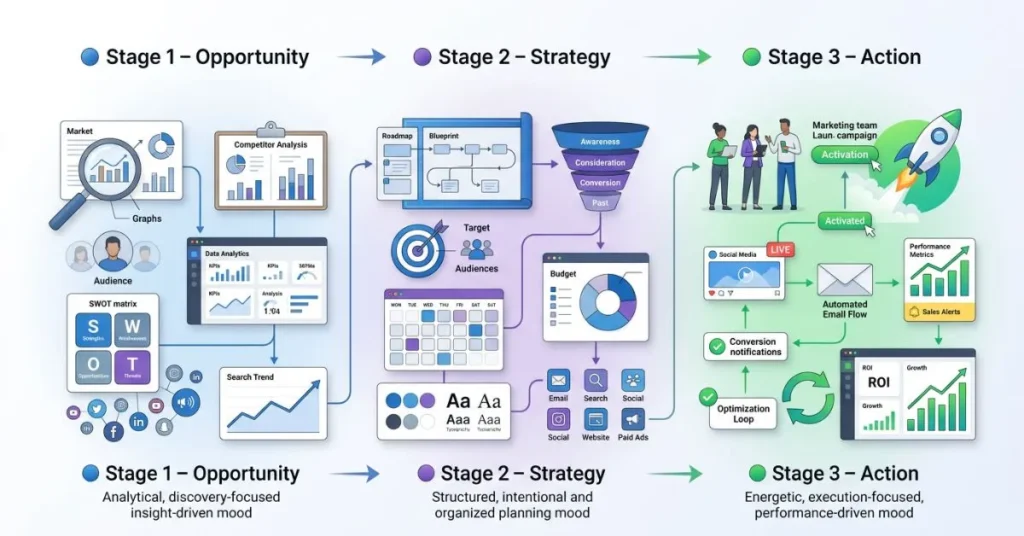
Tactics without planning create random outcomes. A strategy links business goals to channel execution.
Opportunity → Strategy → Action (digital marketing planning framework)
A practical planning cycle:
- Opportunity: market conditions, audience demand, competitor positioning, channel costs
- Strategy: target segments, positioning, messaging, channel mix, measurement plan
- Action: roadmap, budget, creative production, testing plan, reporting cadence
This turns “digital marketing strategies” into an operating system rather than a wish list.
Segmentation, targeting, positioning
- Segmentation: group customers by needs/behavior/context
- Targeting: choose which segments are priority now
- Positioning: articulate why you are the best fit for that segment
Strong positioning increases relevance, which improves conversion rates and lowers CAC.
Buyer personas and customer journey basics
Personas work when they’re based on evidence:
- interviews and sales calls
- support tickets and objections
- analytics: entry pages, drop-offs, repeat behaviors
Journeys are rarely linear. Expect loops (research → comparison → reassurance → delay → re-entry). Plan content and ads to support each stage.
Measurement: KPIs, Attribution, and What “Good” Looks Like
Measurement is what makes digital marketing scalable. But measurement is only useful when definitions match business reality.
Common KPIs (CTR, conversion rate, CAC, LTV, ROAS)
CTR(Click Through Rate): indicates relevance of creative/targeting, not profitability
Conversion rate: shows landing-page and offer effectiveness
CAC(Customer Acquisition Cost): total cost to acquire a customer (define costs consistently)
LTV: long-term value (include churn/retention assumptions)
ROAS: return on ad spend (consider margin and payback period)
“What good looks like” is context-dependent: a high LTV subscription business can afford different CAC than low-margin retail.
Attribution basics (why “last-click” can be misleading)
Last-click attribution tends to over-credit the final interaction (often branded search) and under-credit channels that create demand earlier (video, display, creators, content). Better approaches include:
- using platform attribution as directional signals
- incorporating CRM outcomes (pipeline, retention)
- running incrementality tests where possible
Cross-platform measurement and deduplication (high-level explanation)
Cross-platform measurement tries to answer: how many unique people did we reach, and what incremental outcome did we cause? Key practices:
- consistent naming (UTMs, campaign taxonomy)
- server-side and privacy-aware tracking where applicable
- deduplication between platforms (to avoid double-counting)
- focusing on incremental lift rather than purely attributed conversions
Common Problems and Ineffective Practices (and Why)
Why click-based evaluation can fail
Clicks are easy to optimize and easy to misinterpret. Common failures:
- high CTR, low conversion quality
- cheap traffic that doesn’t match intent
- vanity metrics that don’t correlate with revenue
Use clicks for diagnostics; judge success by qualified actions and downstream outcomes.
Viewability, invalid traffic/ad fraud, and brand safety
Display ecosystems can include:
- ads that are never actually seen (viewability issues)
- non-human traffic (invalid traffic)
- placements next to harmful or misleading content (brand safety)
Risk management requires controls, monitoring, and conservative placement decisions.
Mobile constraints (apps, attention, creative limits)
Mobile marketing fails when:
- pages load slowly
- forms are long and hard to complete
- creative doesn’t match vertical formats
- the app acquisition plan ignores retention
Mobile-first execution is not optional; it’s where many users experience your brand first.
Data, Privacy, and Regulation in Digital Marketing

Digital marketing increasingly operates under strong privacy expectations and legal constraints.
Online behavioral advertising (OBA) and privacy concerns
Behavioral advertising uses signals from browsing/app behavior to target ads. The core tension: relevance vs. privacy. The industry trend is toward:
- more consent requirements
- reduced third-party tracking
- greater emphasis on first-party data and contextual targeting
Privacy laws (worldwide): what changes for marketers
Privacy compliance is now a global requirement. While there isn’t one single “worldwide GDPR,” many countries have enacted privacy laws that affect how marketers collect, store, use, share, and track personal data especially for cookies, advertising identifiers, email/SMS marketing, profiling/targeting, and vendor (processor) management.
Common practical impacts for marketers worldwide:
- Consent and transparency: clearer notices, cookie/SDK consent where required, and truthful disclosures.
- User rights: access, deletion, correction, opting out of sale/sharing/targeted ads (varies by law).
- Data minimization & purpose limits: collect only what you need; use it for declared purposes.
- Vendor/processor contracts: DPAs, security expectations, and accountability across ad-tech partners.
- Cross-border data transfers: extra safeguards in many jurisdictions.
Below are practical, official references you can cite depending on the regions you cover.
Worldwide practical reference portals (by jurisdiction)
European Union (EU)
- Your Europe | Data protection (GDPR overview and rights)
https://europa.eu/youreurope/business/dealing-with-customers/data-protection/index_en.htm
United States (US)
(US privacy is fragmented: state laws + sector rules)
- FTC privacy & data security enforcement overview
https://www.ftc.gov/business-guidance/privacy-security
Canada
Office of the Privacy Commissioner of Canada (PIPEDA)
https://www.priv.gc.ca/en/privacy-topics/privacy-laws-in-canada/the-personal-information-protection-and-electronic-documents-act-pipeda/
Australia
OAIC — Australian Privacy Principles (APPs)
https://www.oaic.gov.au/privacy/australian-privacy-principles
Pakistan
- Ministry of IT & Telecom (MoITT) for official updates on data protection frameworks
https://moitt.gov.pk/
Platform accountability (worldwide): transparency, advertising, and user protection
Platform accountability is now a global issue. Across many jurisdictions, regulators are increasing requirements for transparency, safer platform design, and responsibility for illegal or harmful content, with rules that often touch digital marketing through ad disclosures, targeting limits, political/issue advertising rules, and consumer protection.
Below are practical, official references you can cite depending on the countries you cover:
European Union (EU)
- Digital Services Act (DSA) — European Commission overview
https://digital-strategy.ec.europa.eu/en/policies/digital-services-act
United States (US)
The US is more sector- and state-based rather than one single platform law:
- Federal Trade Commission (FTC) — Advertising and marketing guidance (truth-in-advertising, endorsements, disclosures)
https://www.ftc.gov/business-guidance/advertising-marketing
Australia
- ACCC (Digital platforms & consumer protection work)
https://www.accc.gov.au/
Canada
- Office of the Privacy Commissioner of Canada (PIPEDA guidance/overview)
https://www.priv.gc.ca/en/
Consent, cookies, and first-party data direction
The durable approach for most organizations:
- build direct relationships (subscriptions, accounts, communities)
- collect data transparently
- document consent and give real controls
- rely more on first-party measurement and experiments
E-E-A-T: How to Make a Digital Marketing Article Trustworthy
E-E-A-T (Experience, Expertise, Authoritativeness, Trust) is not a checklist; it’s a credibility outcome.
Editorial policy, author credentials, and update dates
To strengthen trust:
- name the author and show relevant experience
- add an editorial policy (how facts are checked, how updates happen)
- display “last updated” and change notes for major revisions
Google’s guidance on creating helpful content is a useful benchmark:
https://developers.google.com/search/docs/fundamentals/creating-helpful-content
How to cite data sources correctly (and avoid bad stats)
Strong citation habits:
- prefer primary sources (regulators, standards, platform documentation)
- verify methodology for statistics
- avoid copying viral numbers without context
- don’t generalize from one survey to “everyone”
Transparency: conflicts of interest and sponsored content
If you offer services or monetize through affiliates, disclose it clearly. A trust-first approach improves user outcomes and reduces reputational risk.
Glossary
- SEO: Improving organic search visibility
- SEM/PPC: Paid search marketing
- OBA: Online behavioral advertising
- CRM: Customer relationship management
- ROAS: Return on ad spend
- CAC: Customer Acquisition Cost
- LTV: lifetime value
- Attribution: Assigning credit to touchpoints
- Remarketing: Ads to prior visitors/users
- Omnichannel: Consistent experience across channels